Yemen's Maritime Trade and Port Performance: 2021-2025 Diagnostic Period
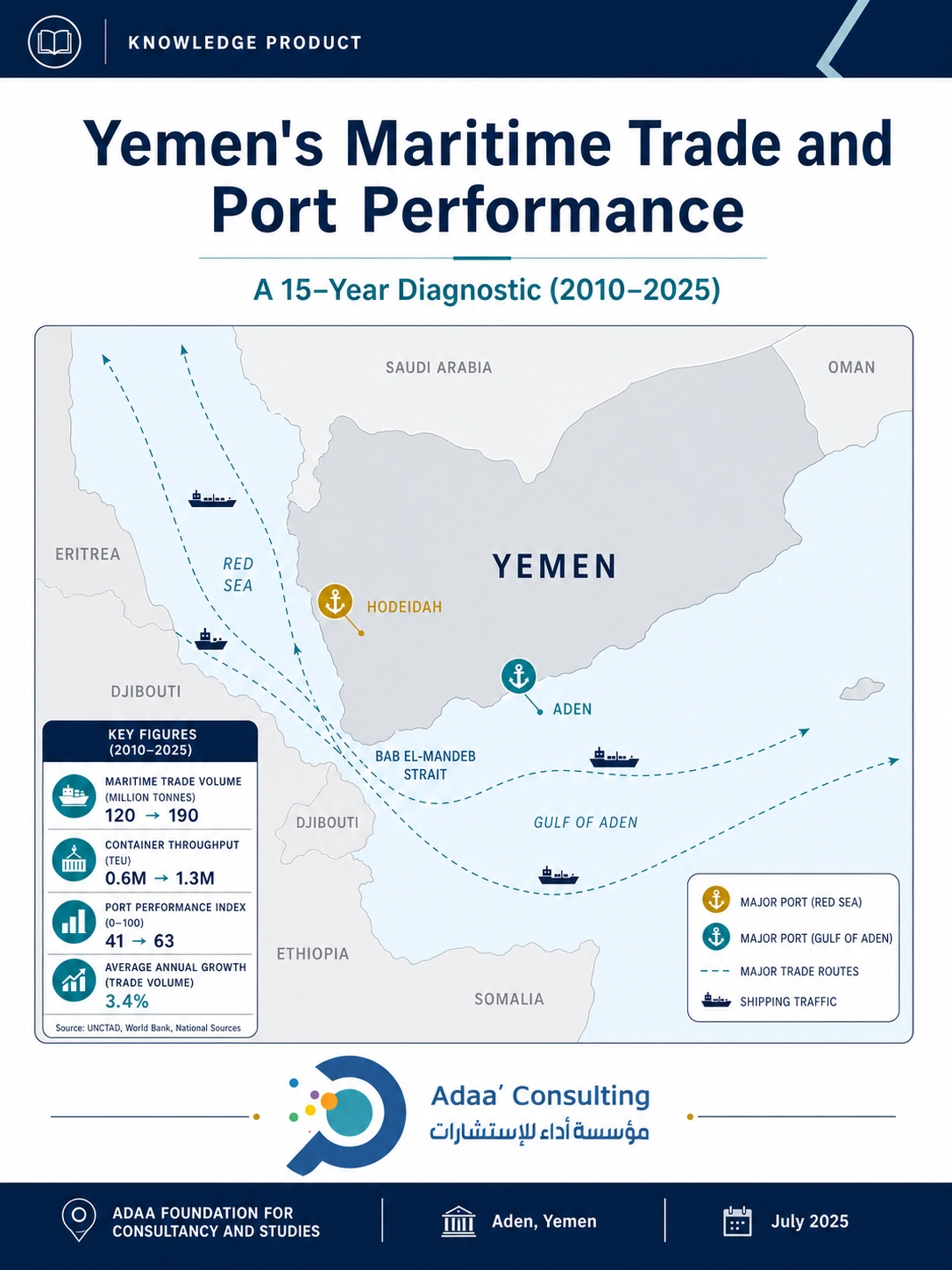
This diagnostic examines the performance of Yemen's maritime trade sector and port institutions over a fifteen year period spanning 2010 to 2025. It is structured around three phases: the pre war baseline of 2008 to 2014, wartime disruption from 2015 to 2020, and the current state through the 2023 to 2026 Red Sea shipping crisis.
Container throughput at Yemen's ports fell from a pre war peak of approximately 775,000 TEU in 2008 to a wartime low of 178,098 TEU in 2015, a decline of 77 percent. Throughput then recovered only partially, reaching an estimated 380,000 TEU by 2024, still roughly half the pre war level. Over the same period, nominal GDP per capita collapsed from US$1,430 in 2014 to US$433 in 2024, and real GDP contracted by 43 percent between 2015 and 2024.
The most consequential development covered in this report is not the throughput collapse itself but a more recent and less visible shift: the inversion of import routing between Yemen's two rival port systems. Prior to the 2022 truce, ports controlled by the internationally recognized government handled approximately 60 percent of Yemen's imports. By 2024, that share had fallen to roughly 25 percent, with 75 percent of imports now routed through Houthi controlled Red Sea ports. This shift transferred the bulk of Yemen's customs revenue base to the de facto authorities in Sana'a, driving a 30 percent decline in government fiscal revenue in 2024 alone and reducing revenues excluding grants to just 2.5 percent of GDP.
The diagnostic's central analytical contribution is the explicit separation of two indicators long treated as a single measure of port performance: physical throughput and fiscal capture. These two measures moved together closely before 2015 but decoupled sharply after 2022. Tonnage moving through Yemen's ports partially recovered, while the state's ability to tax that tonnage deteriorated further. This decoupling is developed through two complementary indices in the report and is presented as the finding most relevant to regional policy.
The report also situates Yemen's trajectory within the 2023 to 2026 Red Sea shipping crisis, during which Houthi attacks on commercial vessels, over 450 recorded maritime security incidents in 2024 alone, collapsed Suez Canal and Bab el Mandeb traffic by an estimated 90 percent at the crisis's peak, forcing global shipping onto the longer Cape of Good Hope route. This shock depressed maritime trade across the entire region, including Gulf Cooperation Council Red Sea ports. Saudi Arabia's King Abdullah Port saw container volumes fall 82.7 percent in 2024, while Gulf facing ports such as Jebel Ali recorded their highest volumes since 2015. The report argues this points to a distinction between chokepoint exposed and Gulf facing infrastructure, rather than a simple divide between Yemen and its Gulf neighbors.
Additional sections cover Yemen's bifurcated port governance structure, the 2021 IRG tariff reform as a case study in self defeating revenue policy, a regional comparative analysis against the UAE and Saudi Arabia, and an assessment of data availability and reliability across all indicators used.
The diagnostic concludes with five recommendations centered on the proposition that port rehabilitation investment will yield limited fiscal return in the absence of unified customs governance, and that physical infrastructure indicators alone are an unreliable proxy for institutional recovery. It calls for adopting a dual index framework for future Yemen maritime trade assessments, tracking import share as a leading fiscal indicator, sequencing infrastructure investment alongside customs harmonization rather than ahead of it, and strengthening regional data and reporting capacity.
Findings draw on the World Bank Yemen Economic Monitor and World Development Indicators, the IMF PortWatch chokepoint monitoring initiative, UNCTAD's Review of Maritime Transport, the UN Panel of Experts on Yemen, the Armed Conflict Location and Event Data Project, the ACAPS Yemen Economic Tracking Interface, the Sana'a Center for Strategic Studies, and Chatham House, supplemented by port level data from DP World, the Aden Ports Development Company, and Gulf port authority statistics.